

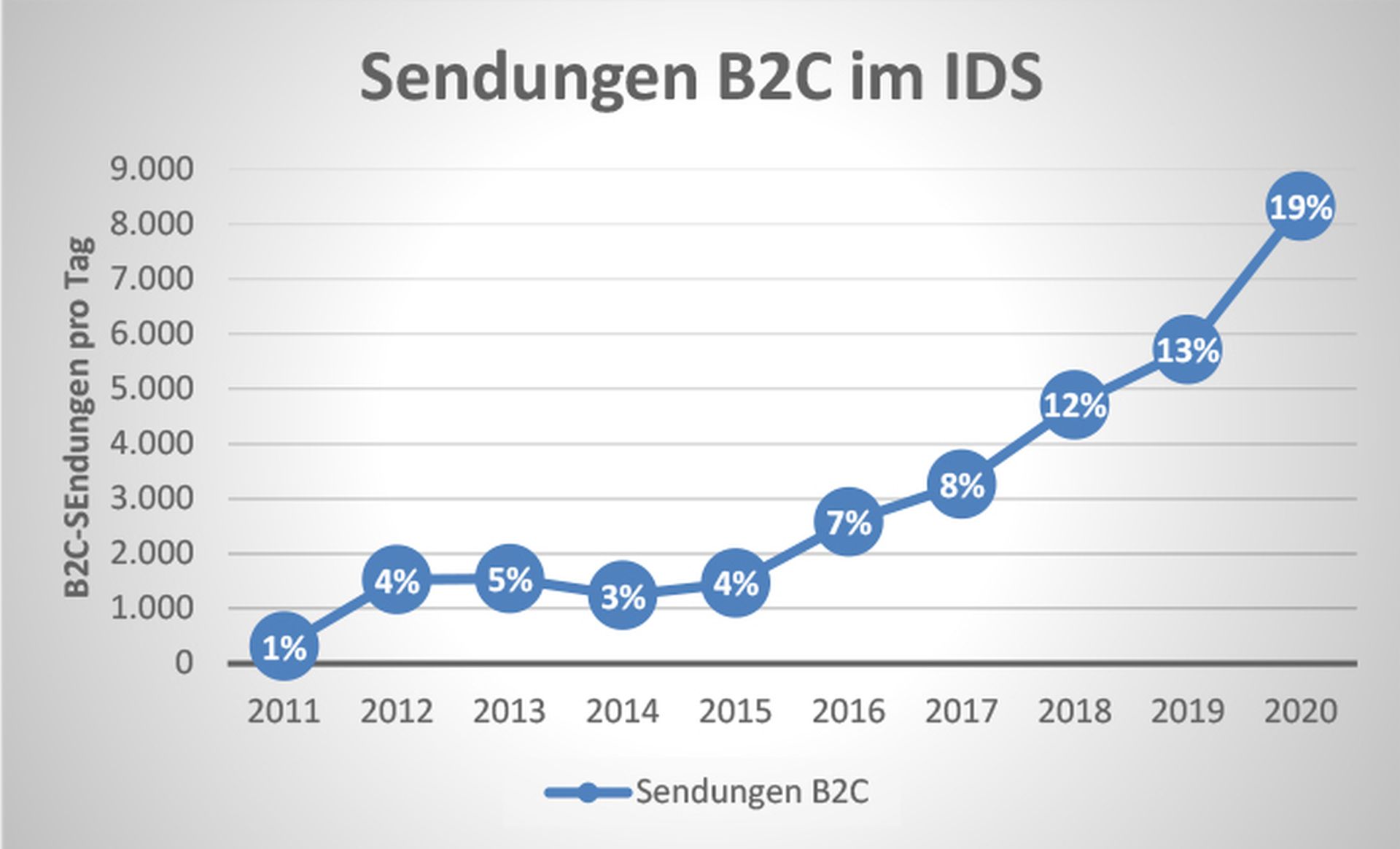
Over the past ten years, IDS Logistik has consistently expanded its B2C offerings in response to the increasing demand for home deliveries throughout Germany. Since launching IDS B2C in 2011, the IDS network has grown to handle around 8,500 private-consumer deliveries per day, up from 300. IDS has now introduced neighbour delivery as an additional service option.
'The importance of B2C shipments within the IDS network has grown significantly,' says Michael Bargl, IDS's managing director. 'While B2C represented less than one per cent of total shipment volume in 2011, this figure reached 19 per cent in 2020. Last year, we transported more than two million B2C shipments for the first time.”
This growth has been driven in part by the rapid expansion of e-commerce. Between 2010 and 2019, online retail sales in Germany tripled. Sectors such as DIY and garden supplies, furniture, sports equipment, and household appliances have increasingly embraced e-commerce as an additional sales channel. The coronavirus pandemic has accelerated this trend even further.
B2C delivery brings different requirements
Compared with deliveries to business customers, delivering freight to private households is considerably more complex. According to Bargl, IDS has continuously optimised its home delivery processes through automation and artificial intelligence. This has enabled the network to handle significant volume peaks, including those experienced during lockdowns related to the pandemic.
The challenges that characterised the early years, such as failed delivery attempts, misunderstandings regarding kerbside delivery terms, cash-on-delivery orders, and communication issues, have largely been resolved through process improvements and enhanced customer communication.
Although services such as cash-on-delivery have become less relevant due to modern payment solutions, IDS has steadily improved its pre-delivery notification services and introduced more precise delivery windows and alternative delivery options. Most recently, recipients can choose to have their delivery left with a neighbour if they are not at home at the agreed time.
Email-Based Delivery Notifications
In 2015, IDS introduced B2C MAIL, a premium service for private consumer deliveries. Customers receive delivery notifications by email or text message as soon as the shipment is loaded at the dispatch depot, typically one day before delivery. This includes a four-hour delivery window.
Recipients can select additional services through a web portal, such as receiving a call from the driver shortly before arrival or authorising the driver to leave the shipment in a designated safe place. These enhancements have reduced average delivery times from three to four days to just one to two days. Today, B2C MAIL accounts for around 40 per cent of all IDS B2C shipments.
Recipient identification and automatic notification standards
In addition to telephone notifications, IDS introduced digital notifications via text message and email for all standard B2C parcels in 2017. On the web portal, private recipients can select their preferred delivery date and other services themselves, such as driver notification, leave-at-door authorisation, or neighbourhood delivery. This brings the total proportion of IDS B2C consignments notified digitally and fully automatically to 60 per cent.
Delivery dates for the remaining 40 per cent of IDS B2C consignments are arranged by telephone via professional, quality-controlled service centres. 'Communication with private recipients is a key quality criterion. To this end, we employ specially trained staff in our service centres who deal exclusively with private recipients. They explain the delivery conditions, provide information on the status of consignments and take and resolve complaints,” says Michael Bargl.
A prerequisite for arranging a delivery appointment is identifying or recognising private addresses as such. In 2018, IDS introduced automatic private recipient recognition using artificial intelligence. Thanks to this, 5 per cent of all parcels are now identified as B2C and routed directly to the correct processing system. This reduces unnecessary journeys and shortens delivery times.
Further services are in the pipeline.
“Looking ahead, it is clear that the decision to shop ‘in-store’ or ‘online’ will be influenced more than ever by logistics. During the lockdown, many new customers discovered that B2C general cargo logistics are reliable and that having large and bulky items delivered is very convenient,” explains Michael Bargl. However, modern consumers want reliable delivery to their preferred address within the narrowest possible time window, and prompt and accurate information should anything go wrong. This clarifies the requirements for general cargo service providers over the next one to three years. If the agreed delivery date cannot be met, the carrier must inform the recipient via smartphone – by text message or email, wherever possible – in real time. IDS will be introducing this service shortly. Also in the pipeline, and already common practice with some parcel services, is the option for recipients to check the estimated time of arrival (ETA) via a link. The end recipient will know, to within plus or minus an hour, when and where their consignment will arrive. 'Therefore, in future, general cargo service providers must be able to offer end customers precise, real-time information in clear language — even in the event of problems — via their mobile phones. This, too, is currently being prepared at IDS," says IDS Managing Director Bargl.