

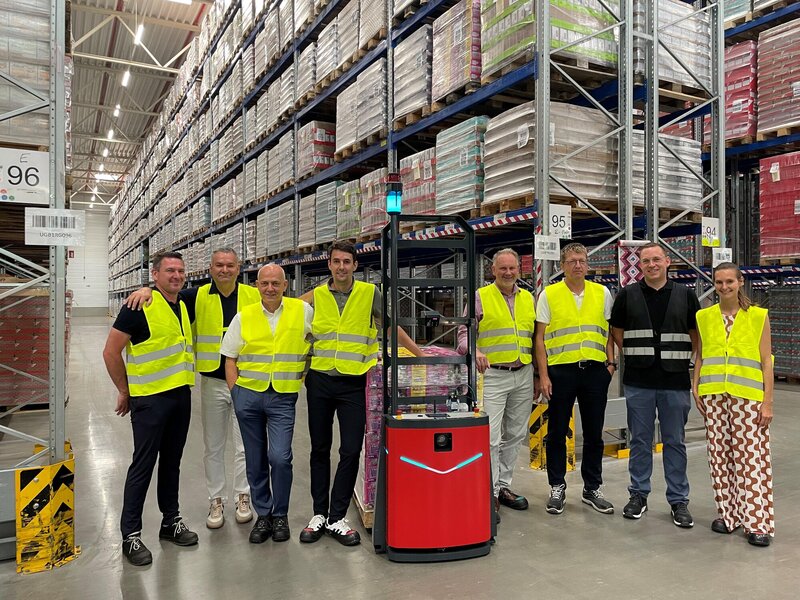
The Noerpel Group has successfully tested driverless high-lift trucks at one of its logistics facilities in Giengen. During the four-week trial, two autonomous transport systems were used to handle internal warehouse movements. This innovative trial attracted significant interest from employees and is now being evaluated in detail. Depending on the outcome of the analysis and the necessary IT adjustments, Noerpel may use autonomous robots in regular operations.
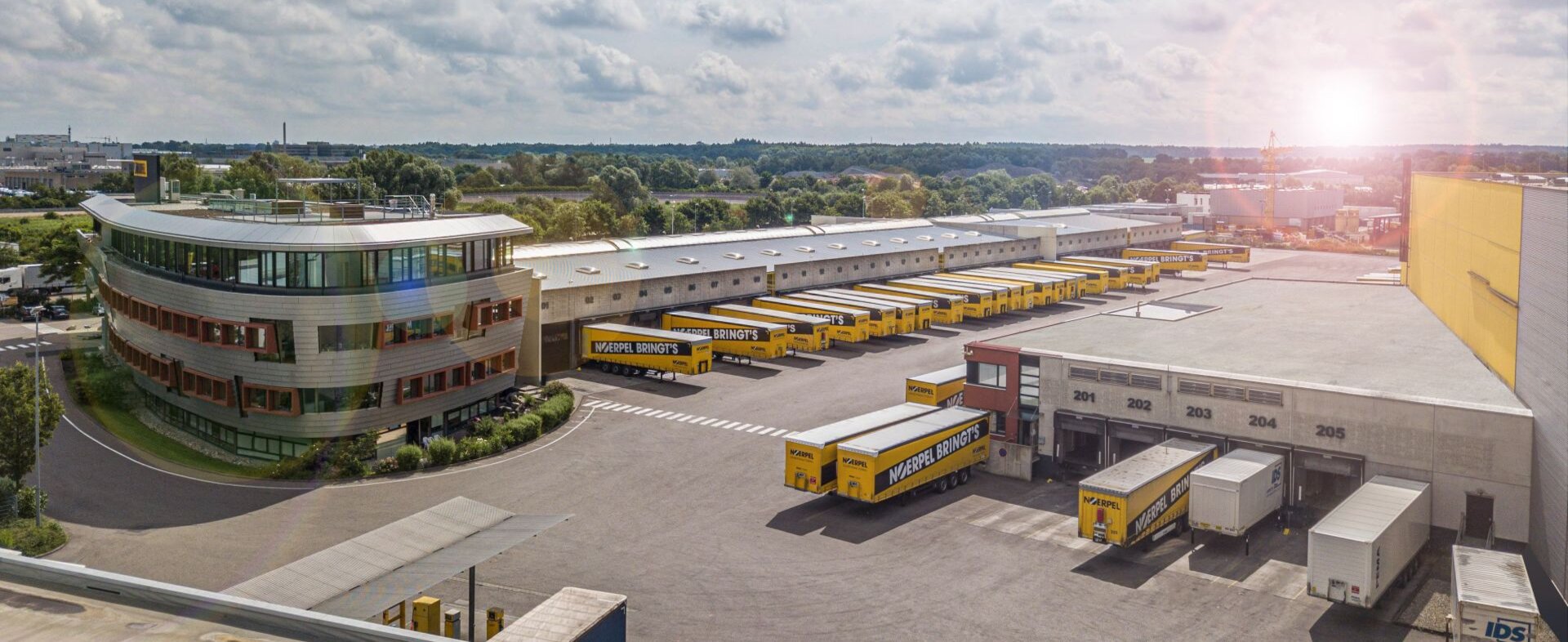
As one of the region’s leading logistics providers, the Noerpel Group operates two logistics centres in Giengen an der Brenz, around 30 kilometres north-east of Ulm. Each facility offers approximately 44,000 square metres of warehouse space. The pilot project took place at the Giengen I site (Am Bühlfeld 2-8), where two autonomous high-lift trucks were tested as part of the internal material flow process. “Digitalisation and automation are among the most important trends shaping the logistics industry,” says Stefan Wuggazer, Branch Manager at Giengen I, adding that “our employees were highly involved throughout the trial, and the project received very positive feedback”.
Long distances within a large warehouse
The Giengen I logistics facility is 500 metres long, resulting in considerable transport distances between the unloading area and storage locations. For the pilot scheme, Noerpel used autonomous guided vehicles (AGVs) to manage these long yet straightforward transport routes.
The practical test was prepared and carried out in close cooperation with an IT service provider. As well as supplying the robots and software, the partner provided the digital platform that controls all processes and coordinates the interaction between employees, robots, software applications, and peripheral equipment.
To enable reliable autonomous transport, a section of the warehouse was first mapped with precision. Areas, rack aisles and fixed obstacles are digitally recorded in detail. The AGVs use this stored map for navigation, moving independently throughout the warehouse to reach any predefined destination.
'These autonomous systems differ significantly from conventional automated vehicles,' explains Lea Schneid, Junior Operational Excellence Manager at Noerpel’s Giengen I location. 'Automated systems often depend on floor-mounted guide rails or numerous fixed markers throughout the facility, whereas autonomous systems navigate independently using their digital map.'
The advantages of autonomous systems
One of the key strengths of autonomous AGVs is their flexibility. Storage allocations and warehouse zone layouts can be changed as required. Rather than modifying the physical infrastructure, operators can simply update the digital map to adapt routes quickly and efficiently.
'The effort involved is relatively low, provided the systems are intuitive and easy to use,' says Stefan Wuggazer. 'In day-to-day operations, employees quickly become confident users and experts in handling the technology.'
In addition to user-friendliness, the pilot evaluated factors such as vehicle speed, pallet weight capacity, and the effort required to establish the necessary IT interfaces.
Following completion of the trial, Noerpel has drawn a positive initial conclusion. The pilot operation ran smoothly overall, and employees showed a strong willingness to integrate the autonomous vehicles into their daily work.
‘As a forward-looking company, we use technological innovation to continuously improve our internal and external processes,’ says Lucas Noerpel-Schneider, Member of the Executive Board of the Noerpel Group. ‘We will now analyse the findings in detail and assess the results together with our IT department. If the AGVs help to reduce the warehouse workload, simplify processes and deliver a positive cost-benefit ratio, there will be nothing to prevent their future deployment in Giengen.'