

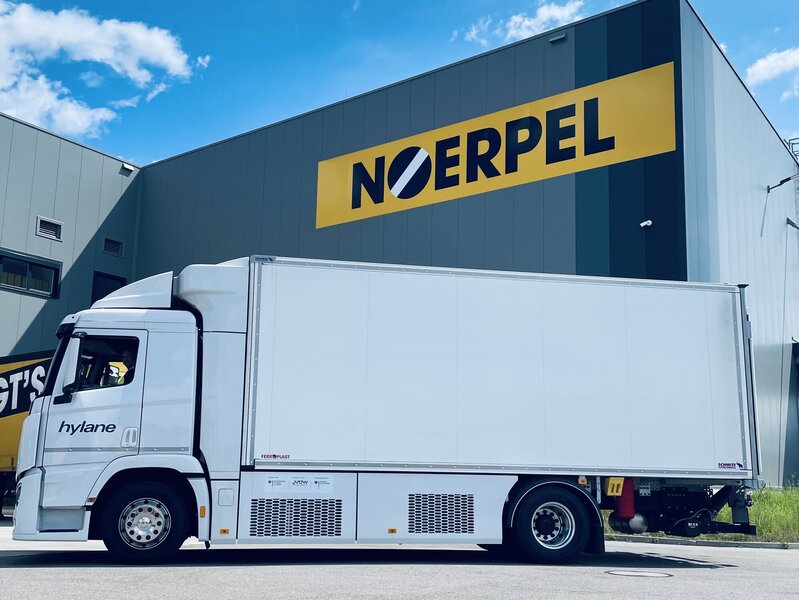
The Noerpel Group is taking further steps towards climate-friendly logistics. At its Heidenheim site, the logistics provider is testing an 18-tonne hydrogen-powered truck under real operating conditions. After two weeks of practical use, the company reported positive initial findings regarding the vehicle's performance and driving characteristics, while maintaining a technology-neutral approach. A trial with a battery-electric tractor unit is also planned at the site.
On 25 July 2024, Noerpel launched the hydrogen truck pilot at its Heidenheim branch. The vehicle was rented from Hylane under a pay-per-use model. 'Our location is ideally suited to the trial because a hydrogen filling station has recently opened in nearby Giengen,' explains Alexa Toberer, Heidenheim Branch Manager. 'This gives us direct access to the infrastructure required for day-to-day operations.'
Two Noerpel drivers have been using the H2 truck on local and regional distribution routes around Heidenheim. The vehicle covers an average of 140 kilometres per day, handling around 19 collection and delivery stops during distribution operations.
Strong performance, challenging economics.
Refuelling takes around 30 minutes and the vehicle has a maximum range of approximately 400 kilometres per tank. However, the 18-tonne truck has a relatively high unladen weight of 12.77 tonnes. Based on an average payload of 6.3 tonnes for distribution transport, the practical test at Noerpel achieved a working range of around 320 kilometres. The operating route included a daily gradient of 5.4 per cent over a distance of 1.4 kilometres.
“In terms of range and performance, the vehicle has fully met our expectations,” says Alexa Toberer. 'However, the purchase price of a hydrogen truck remains very high, and the fuel costs per kilometre for green hydrogen are still significantly higher than those for diesel. At present, this makes economic operation difficult.'
The company’s test drivers have responded positively to the vehicle’s handling characteristics. 'The low centre of gravity provides excellent driving comfort,' says Ms Toberer. ‘Customers are also very interested when deliveries are made and are impressed by the fact that the truck produces little to no engine noise.’
An important operational limitation is that hydrogen-powered trucks are not currently permitted to carry hazardous goods that require labelling under applicable safety regulations. This increases the complexity of transport planning and operational processes.
A variety of technologies will be required.
Although the hydrogen trial is still ongoing, Noerpel has already gained valuable insights. 'From an operational perspective, we are satisfied with the hydrogen technology. However, significant challenges remain in terms of costs and infrastructure before it can be widely adopted in everyday transport operations,' says Viktoria Wessel, Head of Sustainability. 'For hydrogen-powered transport to become viable on a larger scale, particularly for long-haul operations, suitable vehicles must be available and public refuelling infrastructure must be expanded. Overall costs also need to come down.'
At the same time, preparations are underway for a trial of battery-electric trucks in Heidenheim. 'The most suitable drive technology depends on various factors, including available infrastructure, route profiles, loading requirements and transport costs,' says Judith Noerpel-Schneider, Member of the Executive Board of the Noerpel Group. ‘That is why we are pursuing a location-specific mix of alternative powertrain technologies across our fleet. Our objective is to reduce our carbon footprint in the long term and achieve greenhouse gas neutrality by 2050.'
[1 Hydrogen-powered vehicles generate electricity through an electrochemical process within a fuel cell. The only emission produced is water vapour, enabling local emission-free operation.